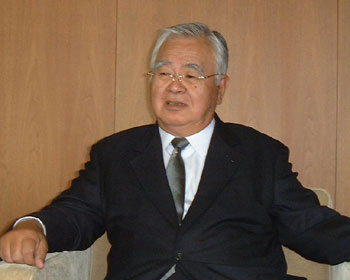
| President Yonekura said that
the financial performance for the March term was better than
it might have been, and that there were many lucky factors
behind this result. However, it is clear that Sumitomo Chemical’s
high (38%) ratio of overseas sales and active investment in
Korea are also major elements in this term’s dramatic profit
increase. The company’s next major project is the Saudi Rabigh
Plan. This involves taking on the challenge of constructing
a complex that will be among the world’s largest that combines
an oil refinery and petrochemicals. “Any concerns like those
about Iran? Not at all!” laughs Yonekura cheerfully. With his
inherent strong leadership and individuality, Yonekura is sure
to continue to lead Sumitomo Chemical steadily forward.
|
| Q: In your March account settlement, you achieved your best performance ever, with consolidated net sales of 1.3 trillion yen and net profits of 64.5 billion yen. How do you feel about this?
|
| I think we had a lucky break.
In petrochemicals, although the prices of crude oil and naphtha
increased dramatically, the positive showing of the economy
in China and the US partly made up for this. This meant that
the product market conditions improved, especially in Asia,
and, although this was insufficient in itself, it still helped
to absorb the higher costs to some extent.
For IT-related business as well, last summer the market entered
an inventory adjustment period. Although I’d been told “if
the price of panels drops by half, the demand will increase
tenfold,” in fact that was not the case, and the demand actually
slowed. However, materials such as the company’s polarizing
film, color filters, and so on have a considerably smaller
excess capacity than that of panel-makers. Moreover, in a move
with good timing, last year for the first time, we constructed
two film plants in Korea. These have achieved a positive showing
right from the start. As a result, this good performance compensated
for the tough market conditions to some extent. |
| Q: We’ve heard various opinions about prospects for this year. What is your own view? |
| In petrochemicals, it depends
on how you see the demand and market conditions in Asia turning
out, but I think it will be down slightly from last year. In
China BASF and several other complexes have been built. Some
people believe that this might herald some kind of shift in
demand. However, the strong demand of China as a whole will
no doubt continue. Growth of around 11% or 12% in petrochemical
products is predicted. Probably the Japanese petrochemical
companies will want to maintain about the same results as last
year. |
| Q: So it seems to strongly depend on trends in the price of crude oil. |
| Yes. However, if you compare
things today with the way they were during the second oil shock,
it’s not so bad. At that time the price of naphtha suddenly
shot up, and the demand in Japan and Asia for petrochemical
products dropped dramatically. It was so bad that we delayed
the start of our company’s factory in Singapore by a year,
after the first phase was completed. Compared to those days,
recently, although the price of crude oil has exceeded $50,
we have not experienced negative growth, so the impact on the
Japanese and global economies is not all that severe. Also,
although it is true that we are partly supported by the economy
of China, the industry itself has developed elasticity.
|
| Your predicted performance for the March 2006 term is net sales of 1.5 trillion yen, operating income of 100 billion yen, and net profits of 65 billion yen. These figures look a little low to us. |
| Under our current mid-term
plan, we set our goals for 2006, the final year, as net sales
of 1.33 trillion yen and net income of 65 billion yen, but
we have already achieved close to this in FY 2004. However,
it does not follow that we can therefore be optimistic about
the future, so we cannot have too high expectations. Nevertheless,
this time we estimated a high yen exchange rate of 100 yen
to the dollar, and the price of naphtha as 38,000 yen. Those
were the factors behind our estimates.
|
| Q: One of the special features of Sumitomo Chemical is the high ratio of overseas sales (38%). Is that a reflection of your progress in global strategy? |
| Recently the greater part
of our investment is overseas, so the overseas ratio of our
sales is naturally going to go up. This year too, looking overseas,
we have the second polarizing film plants in both Taiwan and
Korea, and new plants such as the one producing MMA monomers
in Singapore are starting up. As for domestic investment, there
is really only methionine, and most of that’s for export, so
it’s highly likely that our ratio of overseas sales will continue
to increase.
Domestically, there’s also the reorganization of our facilities
for propylene production facilities in Chiba. We will concentrate
the lines into two main facilities, from the present three.
Although the capacity will be unchanged, the fixed costs will
decrease. Also, the PP for automobile use will be transformed
to the gas phase method, and the propylene oxide will be augmented
from 150,000 tons to 200,000 tons. We have various other plans
such as further EPDM installation, but if we look at it as
a whole, the vast majority of our investment will be overseas.
Our investment budget for this year is roughly from 80 billion
to 100 billion yen over the year. We don’t have any particularly
large projects. |
| Q: We’ve heard that you have purchased the light-emitting polymer business from Dow Chemical. |
| That came about as a result of a direct
approach from Dow’s president. Even before that Sumitomo Chemical
and Dow had been competing intensely in technological development.
Now we are able to make use of Dow’s technology, so that makes
future development easier. Even though I’ve been talking about
international strategy, that doesn’t mean that we’ll actively
tackle just anything. We’ll only do something after proper
consideration of how it fits in with our existing operations.
We don’t intend to take on operations outside our core competencies. |
|
Q: Another of your international projects
is the Rabigh Plan with Saudi Arabia’s ARAMCO. How far have
you got with your FS?
|
|
We’ve already entered the final phase. We’re now conducting
work to finalize the investment amount, within a margin of
error of plus or minus 10%. The plant scale is the same as
we announced previously: 900,000 tons of PE and 700,000 tons
of PP per year, as well as EG, PO, etc. We are working to see
just how much we can keep the investment amount down in each
of those areas, while still maintaining the scale, quality
and function. We should have the final plan pretty much completed
some time in July, and then we will officially sign a joint
venture agreement.
|
|
Q: We hear that your start of operation is planned for 2008; aren’t the investment risks high?
|
|
No, not really. Our initial plan involved a total investment
amount of 4.3 billion dollars. Our basic concept includes getting
financing using Rabigh’s assets as collateral. So, for example,
if the project finance is 70%, that means the capital is 30%,
and since it will be an equal-share company, that means Sumitomo
Chemical’s burden would be 15%. Our plan to start operations
at the factory in 2008 is proceeding on schedule.
|
|
Q: It appears to be a very attractive
location.
|
|
Yes, the location is ideal. It’s close to the markets of
Asia and China, and because it’s on the Red Sea coast, Europe
is just on the other side of the Suez Canal. In terms of transportation
costs, if you compare transporting from Singapore to Shanghai,
and from Rabigh to Shanghai, there’s only a difference of about
one yen per kilogram. We can obtain competitive raw materials,
and there’s a great benefit in that it will be a complex of
the world’s largest class, amalgamated with petroleum refining.
|
|
Q: Aren’t you concerned about the political situation or security in the area?
|
|
No, not at all. It’s true that there was some concern about
terrorism at one point, but later those responsible turned
themselves in and the issue was resolved. Basically Saudi Arabia
is quite secure politically, with everything revolving around
the royal family. They put a lot of effort into security measures.
And lately they’re having local elections and moving towards
greater democracy.
|
| Q: So it won’t turn out like the Iran Petroleum Project did? |
| (smiling): No, that’s
impossible. In those days Iran had hardly any factories built
with foreign capital, and those weren’t yet completed. Nowadays
in Saudi Arabia there are lots of top-class companies from
all over the world. If anything happened, it would be an international
problem. We’re not worried about that at all. |
|